This is a preaching manuscript for my Expository Preaching Class at International Graduate School of Leadership, February 11, 2015.
The True Love Waits Dilemma
The True Love Waits Dilemma
I have come to somewhat despise the
True love Waits movement and what it has done in my life and even to a handful of church leaders and pastors. It's not really their fault. It's not like their teachings are unbiblical. I actually do believe in waiting for the right time with regard to marriage and sex. The problem is actually
what my generation of church leaders have noticed about how we
grew up as a result of True Love Waits. We were told to wait for God’s best, and in turn, be God’s
best ourselves.
But the question then is, who is God’s
best? How do you become one? You see for me, the True Love Waits movement caused
me to view God unknowingly as the ultimate vending machine. That he would give me a super
car Lamborghini of a wife: Expert on the bible, has generations of disciples
under her network of disciples, and has the perfect Christian family! But as we
all know it, God doesn’t really give super cars or even supermen and women.
He can do that, but in whose terms are we defining the super wife? The super husband? The best that God has to offer us?
Kidding aside, in the same way, this caused me not just to view “God’s best” differently from God’s point of view, but also caused me to become the youth leader most churches define as a textbook growing and maturing Christian. That as I long as I attended church, I was going to be just fine and and would naturally grow up like a good church boy should!
However, I found myself time and again, not making the cut and not fitting the bill as "God's Best". I felt that if church people knew about who I really was, they would see me as I was: Not good
enough. True enough, I wasn't the kid who stood out for the right reasons. I was not good enough to remember bible verses and was not great at
answering bible questions in Sunday school. So as I grew up in church, I did my
best performing "church" and tried to look like a choir boy should and presented myself as “God’s Best”. It also shaped and affected how I treated kids my age. Not just with choir girls I tried to impress, but even with other “troubled”
kids: the weird ones, quiet ones, the loud and awkward ones, the confused ones,
and the ones with the tattoos... Kids like myself just trying to fit-in and be welcomed.
I was not aware of it, but I was actually furthering myself away from how God truly viewed me. I somehow faked my way through Sunday School, and hid how I truly felt all because the church was filled with textbook church-loving boy-next-door types. I wanted to be like them to fit in but I didn't want to. I couldn't. Yet I struggled to try because I wanted to fit in badly. So to those who didn't fit the bill? Those who were not choir boys and choir girls? They're nothing but trouble. They're outcasts. They all tried their best to fit in, but they couldn't.
Kidding aside, in the same way, this caused me not just to view “God’s best” differently from God’s point of view, but also caused me to become the youth leader most churches define as a textbook growing and maturing Christian. That as I long as I attended church, I was going to be just fine and and would naturally grow up like a good church boy should!
 |
| photo credit: wagmuna.com |
I was not aware of it, but I was actually furthering myself away from how God truly viewed me. I somehow faked my way through Sunday School, and hid how I truly felt all because the church was filled with textbook church-loving boy-next-door types. I wanted to be like them to fit in but I didn't want to. I couldn't. Yet I struggled to try because I wanted to fit in badly. So to those who didn't fit the bill? Those who were not choir boys and choir girls? They're nothing but trouble. They're outcasts. They all tried their best to fit in, but they couldn't.

In the same way, in light of Luke 18:9-14, Jesus turned the world upside down by
radically challenging the notions and stereotypes people had about the kingdom
of God. People thought they had an idea of who would make the cut to enter in. They thought they had it all pegged as
to who truly is “God’s Best”!
Yet as Jesus revealed in this parable, people’s ideas then were far from the beating of God’s heart, and far from who truly made the cut in his kingdom.
Yet as Jesus revealed in this parable, people’s ideas then were far from the beating of God’s heart, and far from who truly made the cut in his kingdom.
Revisiting an Old Story: The Pharisee and The Tax Collector
So Jesus taught about the parable of the tax collector and the Pharisee because as Luke recorded it, he wanted to paint the picture of how Jesus and his disciples saw and experienced first-hand how people had become cold and judgmental. How they had drawn lines and boundaries among each other, reverting to trusting their own morality and righteousness by treating others poorly
and with contempt (v. 9). This then set the story up by which Jesus, in front of the crowds, described
two contrasting personalities: a Pharisee praying to God and giving
thanks that he was not like a sinner, like the tax collector (v.11), tremendously happy and secured of his stature as a religious man who fasted and
gave tithes regularly (v. 12). While the other, a measly, sinful, hated and ridiculed tax collector, beating on his chest hard, praying and asking for God's forgiveness (v. 13).

The question then, in light of God’s Kingdom and in light of the parable is this: who truly
makes the cut? Who can enter God's kingdom? Why is it that the tax collector, a despised and corrupt sinner, considered
righteous and justified by Jesus as opposed to the religious leader, the expert of
scripture, the devoted spiritually upright Pharisee (v. 14)? Why doesn't the Pharisee make the cut? Wouldn't he be the obvious choice?
Figuring Out the
Kingdom of God
The answer here is that the kingdom of God is
not for those who believe they can earn their way in, but rather for those who believe
that they can’t (John 3:16; Romans 5:8; Ephesians 2:4-5). Perfection is not exactly what God looked for back then and is
surely not looking for the same today. God is not looking for the most well-versed
bible scholar, the most eloquent and active leader, one with the most disciples, the one with the most time spent at church bake sales, medical missions and orphanage outreaches.
Rather, God is looking for those who turn toward him like an ever dependent child, earnestly, constantly in need of the warmth, security and care of the loving arms of a father (v. 14; 18:8, 15-17).
It doesn’t matter then what one has and can accomplish, where a person comes from, her family background, or the content of his bank accounts, or even his past failures, her current struggles, her numerous broken relationships and one night stands. What matters most is that the heart is in its rightful place. A heart that is humble and meek, a heart seeking for forgiveness, mercy and grace, exactly just like the Tax Collector.
Rather, God is looking for those who turn toward him like an ever dependent child, earnestly, constantly in need of the warmth, security and care of the loving arms of a father (v. 14; 18:8, 15-17).
It doesn’t matter then what one has and can accomplish, where a person comes from, her family background, or the content of his bank accounts, or even his past failures, her current struggles, her numerous broken relationships and one night stands. What matters most is that the heart is in its rightful place. A heart that is humble and meek, a heart seeking for forgiveness, mercy and grace, exactly just like the Tax Collector.
Dents, scratches and rough patches
unseen in the naked eye can envelope even the mightiest of super cars, the
flashiest of Lamborghinis. It is in the same way true with us as a people.
People will always have scars, unresolved family issues, past hurts, heartaches
and pains. Yet, in spite of having the same kind of unresolved issues and
having known the truth of God’s love through Christ, why are we still
struggling with how we view and treat other people? Why do we try to tailor fit ourselves and our churches, hoping that we all would be the boy and girl-next-door types, trying hard to look and sound like choir boys and girls? The truth is, God's love abounds for everyone, for all people who seek and desire him earnestly, humbly and repentantly (Matthew 7:7-8)? Yes, even for the tattooed ones, the broken ones, the "back sliding" ones, God's kingdom is for everyone (Romans 8:38-39).

Even inside our churches, why are we still treating gossip as holy sharing of confidential prayer items? Why are we still arduously comparing successes and failures, analyzing them as if we truly know people's motives and minds? Why do we still pass through the hallways of our churches, our campuses, our dorm rooms and kitchen tables wearing a fake, warm smile?
If we are all truly about community, about truth, about God and about Jesus and about the kingdom of God, then why are we still not coming clean with probably our most difficult issue: PRIDE.
If we are all truly about community, about truth, about God and about Jesus and about the kingdom of God, then why are we still not coming clean with probably our most difficult issue: PRIDE.
The Truth about "God’s Best": We All Are
Even when I was in my ugliest,
struggling young self, a kid trying his best not to succumb
to peer pressure, temptation and to raging hormones, I was actually in God’s
standard, “God’s best” not because of who I am, but because of who Christ is (Galatians 2:17-21). Yet I could not embrace the truth about my faith, about being saved by grace, all because of pride. You see, pride blinds us from
viewing ourselves as recipients of grace, and it puts us in a pedestal of
religiosity that contrasts and veers ourselves away from those who are not like us, those who won't fit the bill, those who won't make the cut. So then pride destroys how we ought to view people: with grace, mercy, empathy and
patience.
I learned and experienced
this truth the hard way, that at the most difficult and painful event in my life, I expected wrath, judgment and ridicule from my youth group. So as I confessed my sin and struggles to my youth leaders and pastors, to my surprise, I found
the weirdest of responses. I was embraced. I was assured.
I wasn’t given a painful ear-popping sermon, nor was given the rod and the spanking. I was rebuked hard. I was corrected with the truth of scripture. Yet I was also assured of my place as a disciple, a valuable leader, and a friend. I had fallen into sin, but what my leaders showed me was a compassion I had never felt before. They taught and reminded me that I had not fallen out of my relationship with them, and more importantly, I had not fallen out from the loving assurance and forgiveness of God.
I wasn’t given a painful ear-popping sermon, nor was given the rod and the spanking. I was rebuked hard. I was corrected with the truth of scripture. Yet I was also assured of my place as a disciple, a valuable leader, and a friend. I had fallen into sin, but what my leaders showed me was a compassion I had never felt before. They taught and reminded me that I had not fallen out of my relationship with them, and more importantly, I had not fallen out from the loving assurance and forgiveness of God.
 |
| Photo Credit: trystanowainhughes.files.wordpress.com |
And in moments I needed a shoulder to cry on as a result of loneliness, despair and grief, they were there at my worst... still choosing to accept me, patient with me, a sinning, miserable and struggling young man.
Kingdom of God
Applied: Real Grace
So this is what it means to be truly
humble, to be truly rid of the very same pride that clouded the Pharisee’s
hearts. Are our hearts truly in its rightful place, or are we still faking it, still playing "church", pretending as “God’s
Best”? How have we viewed, treated and talked about other people? If the Tax Collector would show up in our midweek service, in our lobbies, our cafes and our lunch tables, what would be our heart's response?
 |
| Photo Credit: http://epicinvitation.com |
In view then of God’s forgiveness and
mercy through Jesus Christ, we too ought to dispense the very same grace just as it was granted to us, and begin to see ourselves and other people the way God sees us. At the end of the day, like the Tax
Collector weeping for God’s mercy, we all will find acceptance in God’s kingdom
as “God’s best” not because we can earn our way in, but because we understand that we can’t.
Our acceptance is in God, in his loving arms as our father, welcoming us through Jesus Christ.
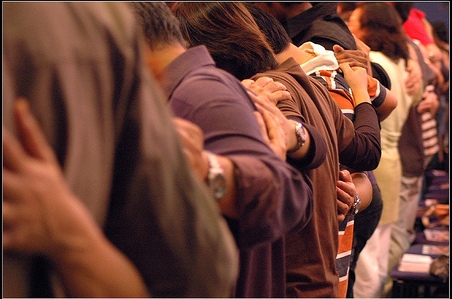
Though we struggle day by day with sin, God willing through the lens of grace, like the Tax Collector, may we too beat and pound our chests in grief. May we, hand in hand as a community, find ourselves all in the same boat, all in need of God’s loving arms, all in need of His mercy and his grace.
Our acceptance is in God, in his loving arms as our father, welcoming us through Jesus Christ.
Though we struggle day by day with sin, God willing through the lens of grace, like the Tax Collector, may we too beat and pound our chests in grief. May we, hand in hand as a community, find ourselves all in the same boat, all in need of God’s loving arms, all in need of His mercy and his grace.